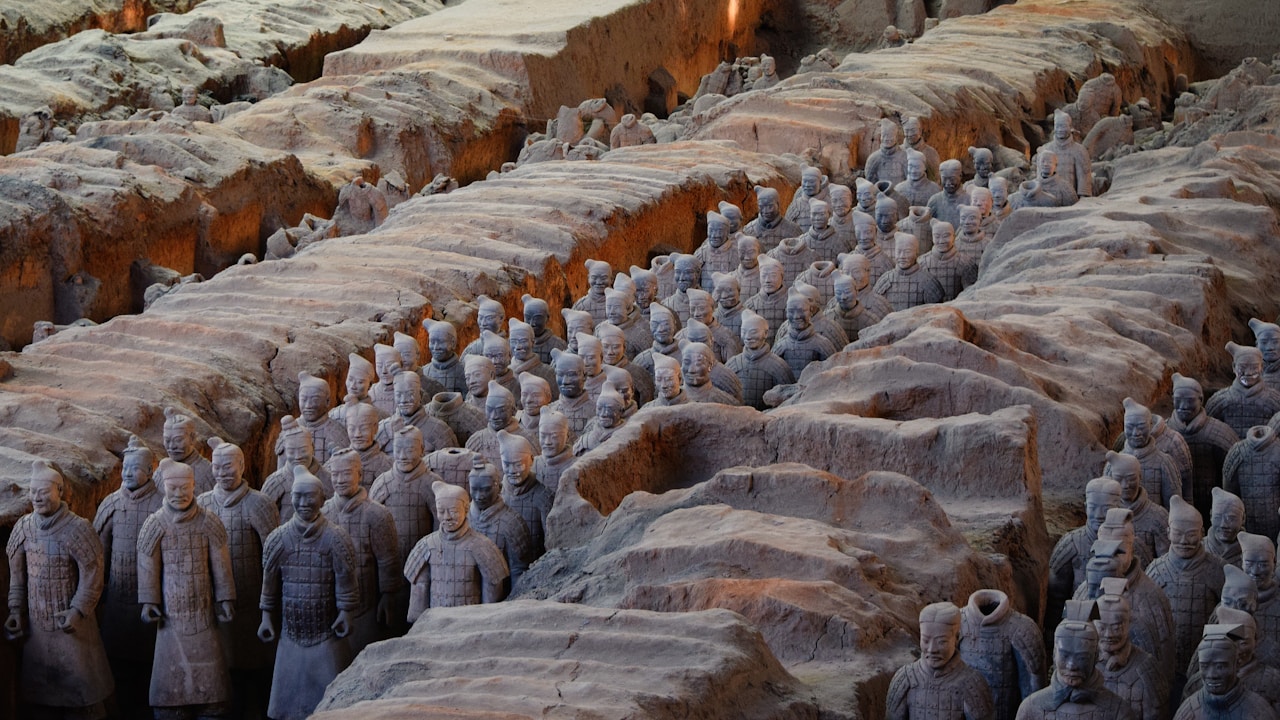
What you are actually looking at
In 1974, farmers digging a well near Xi'an hit ceramic fragments. What followed was one of the great archaeological finds of the century: an army of thousands of life-sized clay figures buried to guard the tomb of Qin Shi Huang, the first emperor to unify China, more than 2,200 years ago.
Standing at the rail of Pit 1 is one of the few moments in travel that genuinely lives up to the photographs. Row upon row of figures, each with a different face, facing east, in a hangar the size of several football pitches.
The pits, in the order you should see them
The museum is laid out as several excavation halls plus a bronze chariot gallery. Going in the wrong order means seeing the subtle pits before the overwhelming one.
- Pit 1 — the big one. Roughly 6,000 figures across a vast hall, infantry and chariots in formation. Start here, walk the length of the hall, then come back along the rail for the front rows.
- Pit 3 — small, but structurally the most interesting: it is thought to be the command post, with a chariot and higher-ranking figures.
- Pit 2 — partly unexcavated on purpose, with cavalry, archers and chariots. Display cases here show the famous kneeling archer and other individually impressive figures.
- Bronze chariot gallery — two half-size bronze chariots with horses, found near the tomb. The most finely made objects on site and the easiest thing to walk past too quickly.
- Lishan Garden / the emperor's mound — included on the same ticket, reached by a free shuttle. A large grassy park with the unexcavated tomb mound. Worth it if you have time and interest; skippable if you are tired.
How long you need
- Minimum: 2.5 hours for pits 1–3 plus the chariots.
- Comfortable: 3.5–4 hours including context and photo stops.
- Full day with the transfer: 6–7 hours door to door from central Xi'an.
Do not try to bolt the city wall bike ride onto the same afternoon. Both are better with energy, and the site is further out than maps suggest.
Tickets: what to know before you go
- The ticket covers the museum and the tomb site, with a free shuttle between them.
- Prices are seasonal: typically around ¥120 in the main season and somewhat less in winter. Treat any figure as a range and confirm when booking.
- Tickets are real-name — book and enter with the passport you will carry.
- Public holidays and summer weekends get very busy; book ahead in those windows.
Avoiding the crowds
Tour groups arrive between 10:00 and 14:00. Two strategies work:
- Arrive at opening. Being at the gate when it opens gives you 60–90 minutes of relatively quiet pits, which is the difference between a good visit and a great one.
- Go late afternoon. Two to three hours before closing is the second quiet window, and the light in Pit 1 is better.
Explanations: the difference between statues and a story
Without context, the pits are impressive for about twenty minutes and then become repetitive. With context — who Qin Shi Huang was, how the figures were made, why they face east, what the excavation is still uncovering — the same hour becomes the highlight of a China trip.
There are audio guides and on-site guides; English-language quality varies a lot, and the busiest ones move quickly. A private companion gives you the history at your pace, handles tickets and transfers, and can tell you which figures matter and why. See the Xi'an travel companion page for how a day is structured.
Common traps around Xi'an and the terracotta site
- Fake terracotta attractions. There are copycat "underground palace" and miniature terracotta sights near the real one. If a taxi driver insists the museum is closed and offers to take you somewhere else, that is the scam. The real site is the Emperor Qinshihuang's Mausoleum Site Museum.
- Shopping-stop tours. The same economics as Beijing: a very cheap day tour pays for itself in shops.
- Drivers who will not use the meter. Agree a price before getting in, or have your hotel arrange the car.
- Assuming the city wall is a short walk away. It is not — the museum is about 40 km east of central Xi'an.
What to combine it with
- Huaqing Pool — on the way back, a Tang-dynasty hot spring complex with genuine history and modern additions.
- Muslim Quarter — the best food evening in the city, and a complete change of pace after a heritage morning.
- City wall at sunset — the single best hour in Xi'an, and better on a second day than squeezed in after the pits.
See how we would sequence it in 2 days in Xi'an.
Quick answers
How long does a Terracotta Warriors visit take?
Allow 2.5 hours minimum for the three pits and the bronze chariot gallery, and 3.5-4 hours for a comfortable visit. Including the transfer from central Xi'an, plan half to three quarters of a day.
How far is the Terracotta Warriors from Xi'an?
About 40 km east of the city centre, which is roughly a one hour drive depending on traffic.
How much are Terracotta Warriors tickets?
Prices are seasonal, typically around CNY 120 in the main season and less in winter, and the ticket also covers the tomb site with a free shuttle. Confirm the current price when booking.
Do I need my passport to visit the Terracotta Warriors?
Yes. Tickets are real-name and are checked against the passport used at booking.
Can I visit the Terracotta Warriors without a guide?
Yes. But without context the pits start to look repetitive after twenty minutes. An audio guide, a good on-site guide, or a private companion makes a large difference to how much you get from it.
Which order should I see the pits in?
Pit 1 first while you are freshest, then Pit 3, then Pit 2, and finish in the bronze chariot gallery. Save the tomb mound for last, or skip it if you are short on time.
Is there a fake Terracotta Warriors site?
Yes. There are copycat attractions near the real museum, and a common scam is a driver claiming the museum is closed and offering an alternative. The genuine site is the Emperor Qinshihuang's Mausoleum Site Museum.
Can I combine the Terracotta Warriors with the city wall in one day?
It is possible but tiring. The museum deserves half a day, and the wall is far better at sunset on a separate day.
Are the Terracotta Warriors suitable for children?
Generally yes. The scale of Pit 1 lands well with kids, though the smaller pits are more static. Bring water and snacks; the site is large and exposed.
Is the site accessible for wheelchairs?
The main halls are largely flat with ramps and viewing platforms, though some paths and the tomb-mound area are uneven. Contact the site ahead if accessibility is a specific concern.