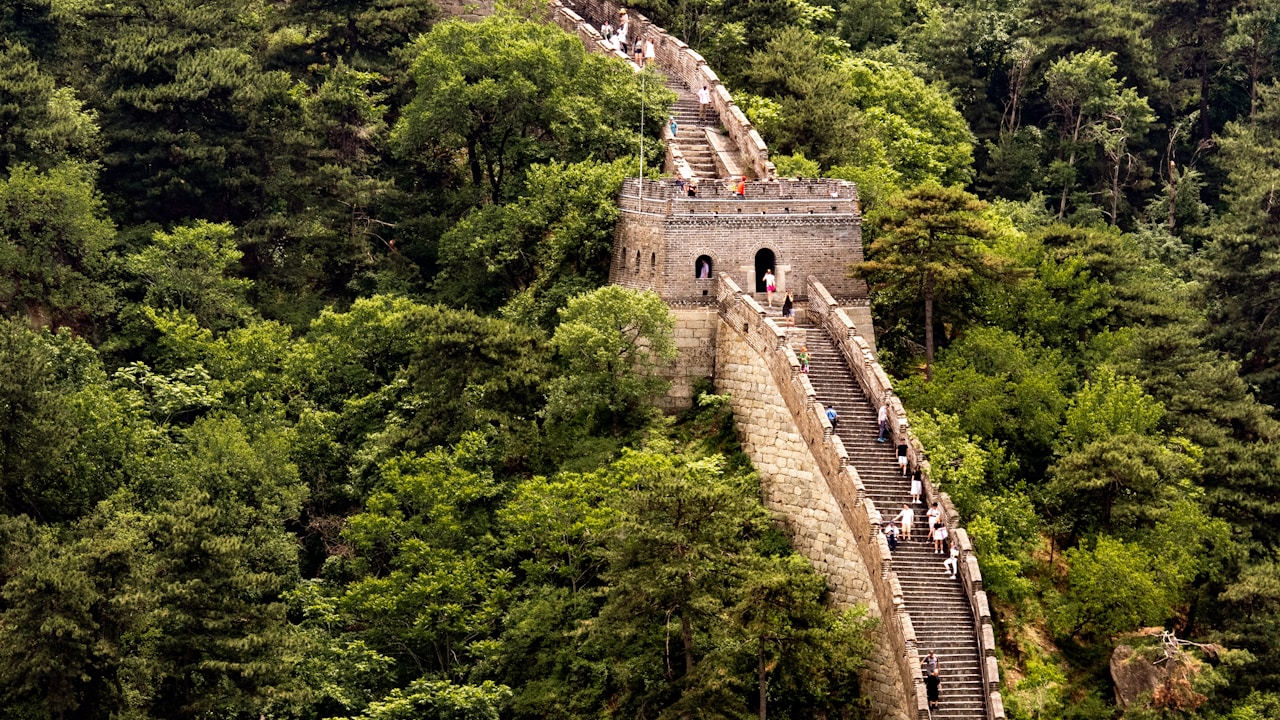
Why Jinshanling instead of the famous sections
Jinshanling sits about 130 km from Beijing, roughly two and a half hours by road. That extra hour buys you three things the famous sections cannot: long empty ridges, a wall that is only partly rebuilt, and the sense that you are walking on something rather than queuing at it.
It is not for everyone. If you have half a day and want the classic photo, go to Mutianyu. If you have a full day, decent shoes, and a preference for views over convenience, Jinshanling is the section people remember years later.
The walk
The classic route runs from the east end towards the west, mostly downhill, and takes about four hours at a relaxed pace with photography stops. A short cable car covers the initial climb at some entry points. The full traverse of the open section is roughly 5–10 km depending on how far you go.
- Easy version: up by cable car, walk 2–3 km of restored wall, come back. Two to three hours.
- Standard version: east to west across restored and semi-restored stretches. Four to five hours.
- Long version: continue to the wilder western end with steeper climbs and un-restored sections. Six hours plus, and you should know what you are doing.
How hard is it, honestly
Harder than Mutianyu, easier than Jiankou. Expect steep stair sections, long ramps at 30–40 degrees, uneven brick, and exposed ridgeline with no shade. There is very little in the way of railings. If you can walk four hours over hilly ground with a daypack, you can do the standard route.
The section is genuinely not suitable if you have knee problems, a fear of heights, or young children who need constant supervision near unguarded drops.
Getting there
There is no train station at Jinshanling. It is a road trip: private car, hired driver, or a companion day. Expect about 2.5 hours each way from central Beijing, longer in holiday traffic. Because of the drive and the walking, this is a genuinely full day — 9–11 hours door to door.
Practical detail worth knowing: ride-hailing coverage at Jinshanling is thinner even than at Mutianyu. A car that waits is not a luxury here, it is the plan. Full options in how to get to the Great Wall.
Best time to go
- September to October: the sweet spot. Clear air, autumn colour, comfortable temperatures.
- April to May: spring, fewer people than autumn, occasional haze.
- Winter: the most dramatic light and the emptiest wall, with the real possibility of snow. Dress for wind and check the section is open.
- Avoid: the first week of October. Even Jinshanling fills up.
What to bring
- Boots or trail shoes with real grip. This is not a section for flat-soled trainers.
- At least 1.5 litres of water per person. There are few vendors along the route.
- Food. Options near the wall are limited; bring more than a snack.
- Wind layer and sun protection — the ridge offers neither shade nor shelter.
- Head torch if you are doing the long version late in the day.
- Your passport for real-name ticketing.
Safety notes
- Stay on restored wall where you can. The un-restored sections have loose brick and real drops.
- Turn back earlier than you think you need to. Daylight goes quickly in winter.
- Do not attempt this section in a thunderstorm or high wind — the ridge is fully exposed.
- Do not attempt Jiankou from here as a casual extension. It is un-restored and dangerous.
Is a companion worth it here?
More than at any other section. The drive is long, there is no public transport, the return leg needs arranging, and the route has choices to make — where to start, how far to go, which towers have the best light. A companion handles all of that and adds the history: how the wall was garrisoned, why the towers are spaced as they are, and what you are looking at across the valleys.
Quick answers
Where is Jinshanling and how far is it from Beijing?
It is about 130 km north-east of Beijing, roughly two and a half hours by road. There is no train station, so a car or private day is the only practical option.
How long is the Jinshanling hike?
The classic east-to-west route is roughly 5-10 km and takes about four hours at a relaxed pace. A short version using the cable car can be done in two to three hours.
Is Jinshanling harder than Mutianyu?
Yes. Expect steeper ramps, uneven brick, un-restored stretches and no shade. It is manageable for anyone comfortable with four hours of hilly walking, but it is a step up from Mutianyu.
Is Jinshanling crowded?
Far less than Badaling or Mutianyu. Even on busy weekends you will find long stretches with very few people; on a weekday in low season it can feel almost empty.
Can I visit Jinshanling in winter?
Yes, and it is spectacular with snow. Dress warmly for wind on the ridge and check that the section is open before you drive out.
Are there facilities at Jinshanling?
Basic: toilets and a few vendors near the entrances. Along the wall itself there is very little, so carry your own water and food.
Is Jinshanling suitable for children?
For older children who can walk several hours, yes. For young children it is not ideal: there are unguarded drops and no railings on much of the route.
What is the difference between Jinshanling and Jiankou?
Jinshanling is restored to a walkable standard and open to visitors. Jiankou is un-restored, crumbling and genuinely dangerous. Do the former, look at photos of the latter.