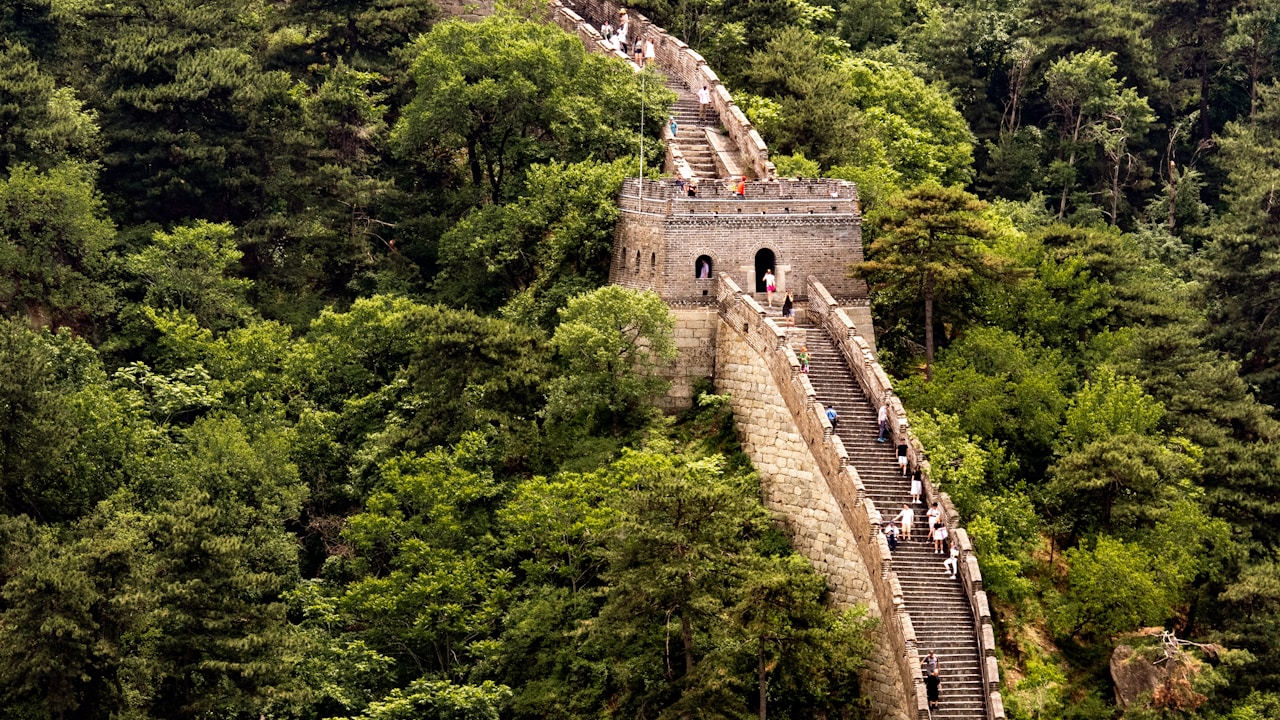
The 30-second answer
Go to Mutianyu unless you have a specific reason not to. It looks more like the wall you imagined, the crowds are a fraction of Badaling's, and the cable-car-up and toboggan-down combination makes it workable for almost any fitness level.
Go to Badaling if your priority is the shortest possible journey, you want the most famous name, or stairs and long walks are a genuine constraint.
Side by side
| Mutianyu | Badaling | |
|---|---|---|
| Distance from Beijing | About 70 km, 1.5–2 hrs by road | About 70 km, 1–1.5 hrs; 30–40 min by high-speed train |
| Crowds | Moderate, concentrated near the cable car | Heavy, especially 10:00–14:00 |
| Scenery | Forest-covered ridges, well-preserved towers | Broad, open, dramatic mountains; more rebuilt |
| Effort | Easy to moderate; long flat-ish stretches plus steep sections | Easy access, but some very steep climbs |
| Lifts | Cable car, chairlift, toboggan down | Cable car |
| Public transport | Awkward: bus plus transfer, or a tour shuttle | Easy: high-speed train direct to Badaling Great Wall station |
| Facilities | Good; restaurants and shops at the base | Extensive; the most developed of any section |
| Best for | Most first-timers, families, photographers | Tight schedules, limited mobility, name recognition |
Choose Mutianyu if…
- You care about photographs and do not want strangers in all of them.
- You are travelling as a family and want the toboggan as a reward at the end.
- You would rather spend an extra 30 minutes driving than an extra hour queueing.
- You want to walk for three hours on varied terrain rather than one steep climb.
Choose Badaling if…
- You are short on time and the train gets you there in well under an hour.
- Mobility is limited and minimising walking distance matters more than atmosphere.
- You specifically want the section everyone at home will recognise.
- You are travelling in deep winter, when its facilities and access are the most reliable.
The third option nobody considers
If the choice feels like a compromise between "crowded" and "inconvenient", it usually is. Jinshanling sits about two and a half hours out and offers what neither of the two famous sections can: long empty ridges, a genuine hike, and a mix of restored and semi-wild wall. Simatai is the option if you want the wall lit at night, paired with Gubei Water Town.
Crowds, kids and mobility
Crowds: both sections concentrate people within a few hundred metres of the lift. Walking 20 minutes further along the ridge — in either direction — usually halves the number of people around you. Arriving at opening time is the other half of the solution.
Kids: Mutianyu wins. The toboggan turns the descent into the highlight of the trip, and the terrain is more forgiving.
Mobility: Both have cable cars, but the wall itself is steep stone with no handrails in most places. If stairs are a problem, treat the cable car as the way to see the view from a tower rather than the start of a long walk.
Getting there
This is where the two diverge most. Badaling has a high-speed train station named after it. Mutianyu does not, which means road transport — tour shuttle, hired car, or a bus-and-transfer combination that costs you an extra hour each way. Full breakdown on how to get to the Great Wall from Beijing.
Quick answers
Is Mutianyu or Badaling better for first-time visitors?
Mutianyu, for most people. The scenery is better, the crowds are lighter and the toboggan descent makes it fun rather than just tiring. Badaling is better if you need the fastest, easiest transfer.
Which Great Wall section is less crowded?
Mutianyu is considerably less crowded than Badaling. Between the two famous sections, Mutianyu is the quieter choice; Jinshanling is quieter still.
Can I take a train to Mutianyu?
Not directly. There is no station at Mutianyu, so it is a road trip: hired car, tour shuttle, or a bus plus local transfer. Badaling is the section with direct high-speed train access.
How long do I need at Mutianyu?
Three to four hours on the wall is a satisfying visit. Add 1.5-2 hours of driving each way from central Beijing.
Is the toboggan at Mutianyu worth it?
Yes, particularly for families and for anyone whose knees have had enough of descending steep steps. It is a separate ticket from the cable car.
Which section is more authentic?
Both Badaling and Mutianyu are restored. Jinshanling and Simatai retain more original structure and feel wilder, which is why serious walkers prefer them.
Can I visit both sections in one day?
It is possible with a private car but not enjoyable. You would spend most of the day driving and get a rushed version of each.
Do I need a passport for Mutianyu or Badaling?
Yes. Tickets at both sections are real-name and are checked against the passport used at booking.